Page 82 - lef-105
P. 82
Crédit photo : IRD – Christian Lamontagne
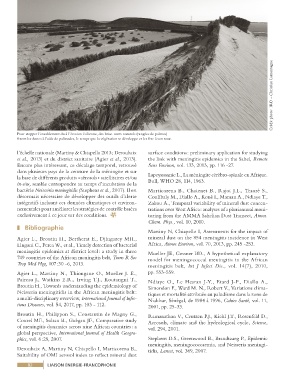
Pour stopper l’ensablement du à l’érosion éolienne, des brise-vents naturels (rangées de palmes)
fixent les dunes à l’aide de palissades, le temps que la végétation se développe et les fixe à son tour.
l’échelle nationale (Martiny & Chiapello 2013 ; Deroubaix surface conditions : preliminary application for studying
et al., 2013) et du district sanitaire (Agier et al., 2013). the link with meningitis epidemics in the Sahel, Remote
Encore plus intéressant, ce décalage temporel, retrouvé sens Environ, vol. 133, 2013, pp. 116 -27.
dans plusieurs pays de la ceinture de la méningite et sur
la base de différents produits « aérosols » satellitaires et/ou Lapeyssonnie L., La méningite cérébro-spinale en Afrique.
in-situ, semble correspondre au temps d’incubation de la Bull, WHO 28, 114, 1963.
bactérie Neisseiria meningitidis ( Stephens et al., 2007). Il est Marticorena B., Chatenet B., Rajot J.L., Traoré S.,
désormais nécessaire de développer des outils d’alerte Coulibaly M., Diallo A., Koné I., Maman A., Ndiaye T.,
intégratifs incluant ces données climatiques et environ- Zakou A., Temporal variability of mineral dust concen-
nementales pour améliorer les stratégies de contrôle basées trations over West Africa : analyses of a pluriannual moni -
exclusivement à ce jour sur des conditions. toring from the AMMA Sahelian Dust Transect, Atmos.
Chem. Phys., vol. 10, 2010.
bibliographie Martiny N, Chiapello I, Assessments for the impact of
Agier L., Broutin H., Bertherat E., Djingarey MH., mineral dust on the 854 meningitis incidence in West
Lingani C., Perea W., et al., Timely detection of bacterial Africa, Atmos Environ, vol. 70, 2013, pp. 245 -253.
meningitis epidemics at district level : a study in three Mueller JE, Gessner BD., A hypothetical explanatory
749 countries of the African meningitis belt, trans R soc model for meningococcal meningitis in the African
trop med Hyg, 107 :30 -6, 2013. meningitis belt, Int J Infect dis., vol. 14(7), 2010,
Agier L., Martiny N., Thiongane O., Mueller J. E., pp. 553-559.
Paireau J., Watkins E.R., Irving T.J., Koutangni T., Ndiaye O., Le Hesran J-Y., Etard J-F., Diallo A.,
Broutin H., Towards understanding the epidemiology of Simondon F., Ward M. N., Robert V., Variations clima-
Neisseria meningitidis in the African meningitis belt : tiques et mortalité attribuée au paludisme dans la zone de
a multi- disciplinary overview, International Journal of Infec- Niakhar, Sénégal, de 1984 à 1996, Cahier santé, vol. 11,
tious diseases, vol. 54, 2017, pp. 103 - 112. 2001, pp. 25-33.
Broutin H., Philippon S., Constantin de Magny G., Ramanathan V., Crutzen P.J., Kiehl J.T., Rosenfeld D.,
Courel MF., Sultan B., Guégan JF., Comparative study Aerosols, climate and the hydrological cycle, science,
of meningitis dynamics across nine African countries : a vol. 294, 2001.
global perspective, International Journal of Health Geogra-
phics, vol. 6 :29, 2007. Stephens D.S., Greenwood B., Brandtzaeg P., Epidemic
Deroubaix A, Martiny N, Chiapello I, Marticorena B., meningitis, meningococcaemia, and Neisseria meningi-
tidis, Lancet, vol. 369, 2007.
Suitability of OMI aerosol index to reflect mineral dust
82 liaison énergie-francophonie
Pour stopper l’ensablement du à l’érosion éolienne, des brise-vents naturels (rangées de palmes)
fixent les dunes à l’aide de palissades, le temps que la végétation se développe et les fixe à son tour.
l’échelle nationale (Martiny & Chiapello 2013 ; Deroubaix surface conditions : preliminary application for studying
et al., 2013) et du district sanitaire (Agier et al., 2013). the link with meningitis epidemics in the Sahel, Remote
Encore plus intéressant, ce décalage temporel, retrouvé sens Environ, vol. 133, 2013, pp. 116 -27.
dans plusieurs pays de la ceinture de la méningite et sur
la base de différents produits « aérosols » satellitaires et/ou Lapeyssonnie L., La méningite cérébro-spinale en Afrique.
in-situ, semble correspondre au temps d’incubation de la Bull, WHO 28, 114, 1963.
bactérie Neisseiria meningitidis ( Stephens et al., 2007). Il est Marticorena B., Chatenet B., Rajot J.L., Traoré S.,
désormais nécessaire de développer des outils d’alerte Coulibaly M., Diallo A., Koné I., Maman A., Ndiaye T.,
intégratifs incluant ces données climatiques et environ- Zakou A., Temporal variability of mineral dust concen-
nementales pour améliorer les stratégies de contrôle basées trations over West Africa : analyses of a pluriannual moni -
exclusivement à ce jour sur des conditions. toring from the AMMA Sahelian Dust Transect, Atmos.
Chem. Phys., vol. 10, 2010.
bibliographie Martiny N, Chiapello I, Assessments for the impact of
Agier L., Broutin H., Bertherat E., Djingarey MH., mineral dust on the 854 meningitis incidence in West
Lingani C., Perea W., et al., Timely detection of bacterial Africa, Atmos Environ, vol. 70, 2013, pp. 245 -253.
meningitis epidemics at district level : a study in three Mueller JE, Gessner BD., A hypothetical explanatory
749 countries of the African meningitis belt, trans R soc model for meningococcal meningitis in the African
trop med Hyg, 107 :30 -6, 2013. meningitis belt, Int J Infect dis., vol. 14(7), 2010,
Agier L., Martiny N., Thiongane O., Mueller J. E., pp. 553-559.
Paireau J., Watkins E.R., Irving T.J., Koutangni T., Ndiaye O., Le Hesran J-Y., Etard J-F., Diallo A.,
Broutin H., Towards understanding the epidemiology of Simondon F., Ward M. N., Robert V., Variations clima-
Neisseria meningitidis in the African meningitis belt : tiques et mortalité attribuée au paludisme dans la zone de
a multi- disciplinary overview, International Journal of Infec- Niakhar, Sénégal, de 1984 à 1996, Cahier santé, vol. 11,
tious diseases, vol. 54, 2017, pp. 103 - 112. 2001, pp. 25-33.
Broutin H., Philippon S., Constantin de Magny G., Ramanathan V., Crutzen P.J., Kiehl J.T., Rosenfeld D.,
Courel MF., Sultan B., Guégan JF., Comparative study Aerosols, climate and the hydrological cycle, science,
of meningitis dynamics across nine African countries : a vol. 294, 2001.
global perspective, International Journal of Health Geogra-
phics, vol. 6 :29, 2007. Stephens D.S., Greenwood B., Brandtzaeg P., Epidemic
Deroubaix A, Martiny N, Chiapello I, Marticorena B., meningitis, meningococcaemia, and Neisseria meningi-
tidis, Lancet, vol. 369, 2007.
Suitability of OMI aerosol index to reflect mineral dust
82 liaison énergie-francophonie